May 27, 2026

The dropout problem in antidepressant research is a recruitment problem.

Mental Health Awareness Month is the right moment to stop calling completion a site problem. It is upstream of the site.

When a psychiatric drug trial struggles to keep participants enrolled, the conversation usually turns to the sites. Site staff get asked to follow up more often, schedule more carefully, and chase harder.

But the data points somewhere else. The pattern that drives dropout in antidepressant research begins well before a patient ever walks into a site. It begins at recruitment.

What the data shows

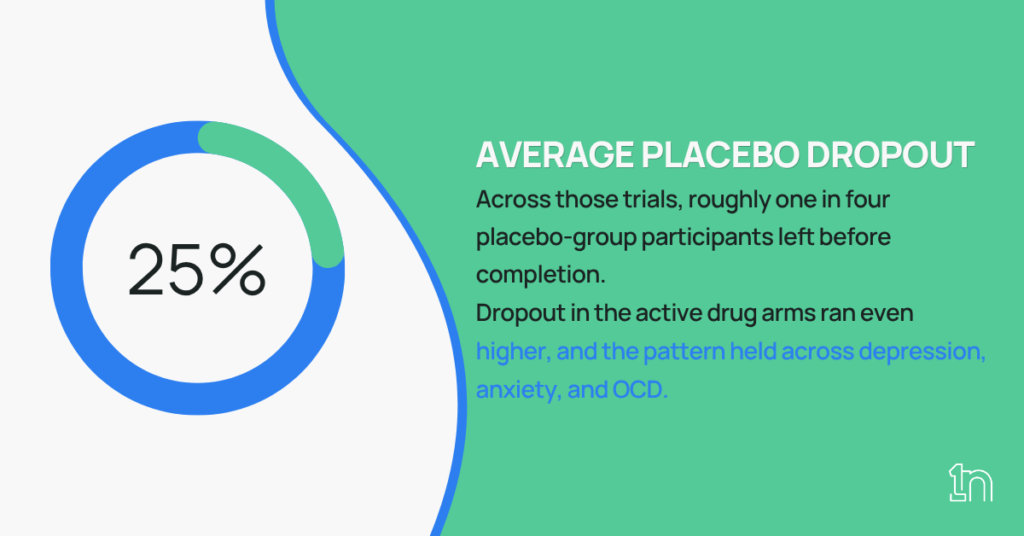
One of the largest looks at this question examined 148 antidepressant trials covering 18,016 participants in placebo groups alone.¹

This was not a quirk of one protocol or one therapeutic area. It was consistent enough to treat as a structural feature of how these trials are built and filled.

The drivers were operational

When researchers compared trials with high dropout to trials with low dropout, the factors that stood out were design and logistics, not clinical profile. Three came up again and again.

  • Trial length
  • Visit frequency
  • Placebo lead-in

Burden is not the same as a retention problem

Here is the part that matters most, and the part that is easiest to get wrong. Longer trials, more frequent visits, and placebo lead-in periods all increase the burden a study asks a patient to carry. But burden on its own does not have to create a retention problem.

It becomes a retention problem when patients enroll without a clear, honest picture of what they agreed to. A patient who is surprised by the time commitment, the travel, or the placebo design is a patient at risk of leaving. A patient who understood all of it before signing on is not. The variable is not burden. It is informed enrollment.
What recruitment actually controls

Recruitment cannot shorten a protocol or remove a placebo lead-in. Those are fixed by the time a campaign begins. What recruitment can do is make sure the people who enter the funnel enter it prepared, with an accurate understanding of what the study will ask of them, and a decision, made with that understanding, that they still want to take part.

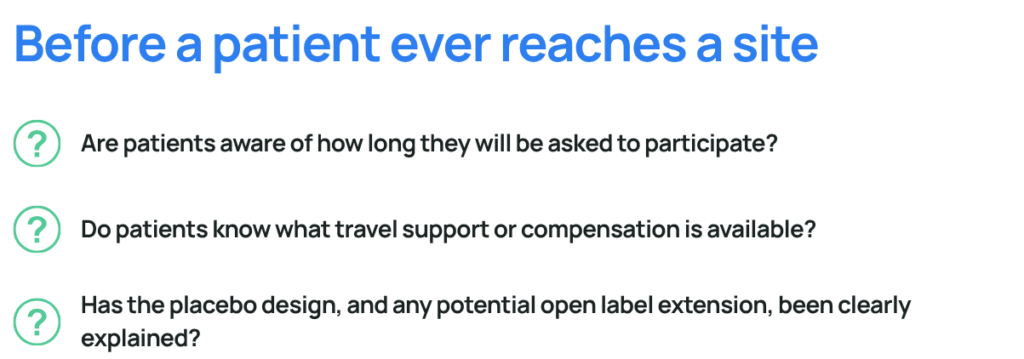
A few questions worth asking of any psychiatric trial recruitment effort.

If the answer to any of these is unclear, retention risk is being built in before the first visit is ever scheduled.

Retention does not start at the first dose. It starts at the first interaction.

The first contact a patient has with a study is where expectations are set, and where trust is either built or quietly undermined. That is why we treat recruitment and retention as one continuous responsibility, not two separate problems handed between teams.

For Mental Health Awareness Month, it is worth restating plainly. The people who raise their hand for antidepressant research deserve to know exactly what they are saying yes to. Getting that right is how studies finish.

¹ Li F, Nasir M, Olten B, Bloch MH. Meta-analysis of placebo group dropout in adult antidepressant trials. Prog Neuropsychopharmacol Biol Psychiatry. 2020;98:109777. View on PubMed

More from the 1nHealth blog

AI is not the ‘what’. It is simply the ‘how’.

Sponsors are tired of hearing what powers the work. They want to know what the work actually delivers.

What keeps people of color out of clinical trials

Most campaigns treat underrepresentation as the problem. The research says distrust is the cause.

Why Applying to a Depression Study Takes Courage

The symptoms that define depression are the same ones that make seeking help hard. Recruitment that ignores that builds its own enrollment gap.